
Up at four. Coffee. Twenty minutes of brain work — Dutch, a chess problem, some math, the crossword. Cold plunge. Mobility. Then the gym — isometrics, plyometrics and VO2 max today.
Then I self-taped an audition for a commercial.
Then I made four calls and asked people for money.
That’s not a highlight reel from 1994. That was today, before lunch, and tomorrow looks about the same.
I’ve done four things for a living: played football in the NFL; managed over $500 million in assets on Wall Street; acted in TV, movies, commercials and stage plays, something I still do when I can get a gig; and sold high-ticket, which I also still do.
Nobody plans that. I got cut, I got bored, I saw a movie, I needed money — roughly in that order. There was no strategy and I’d be lying if I told you there was one.
But here’s what you get out of doing all of it for real, over thirty years, instead of reading about any of it: eventually you notice they’re not four things.
They’re three kinds of training. And they only work in one order.
Nobody does. You get a life, not a program. Things land on you, you take the work that’s in front of you, and if you’re lucky you’re good at some of it.
The order only becomes visible afterward, and only if you’ve actually been in all the rooms. That’s the whole reason I can see it and most people can’t. Not because I’m smarter. Because I’ve been in all four rooms and I’m still in three of them this week.
What I couldn’t have told you at twenty-five, or at forty, is that there’s a sequence to training a person in this stuff. Any person. A footballer, a closer, a trial lawyer, whoever you’ve got.
It took me sitting down and writing a development plan for somebody else before I saw it.
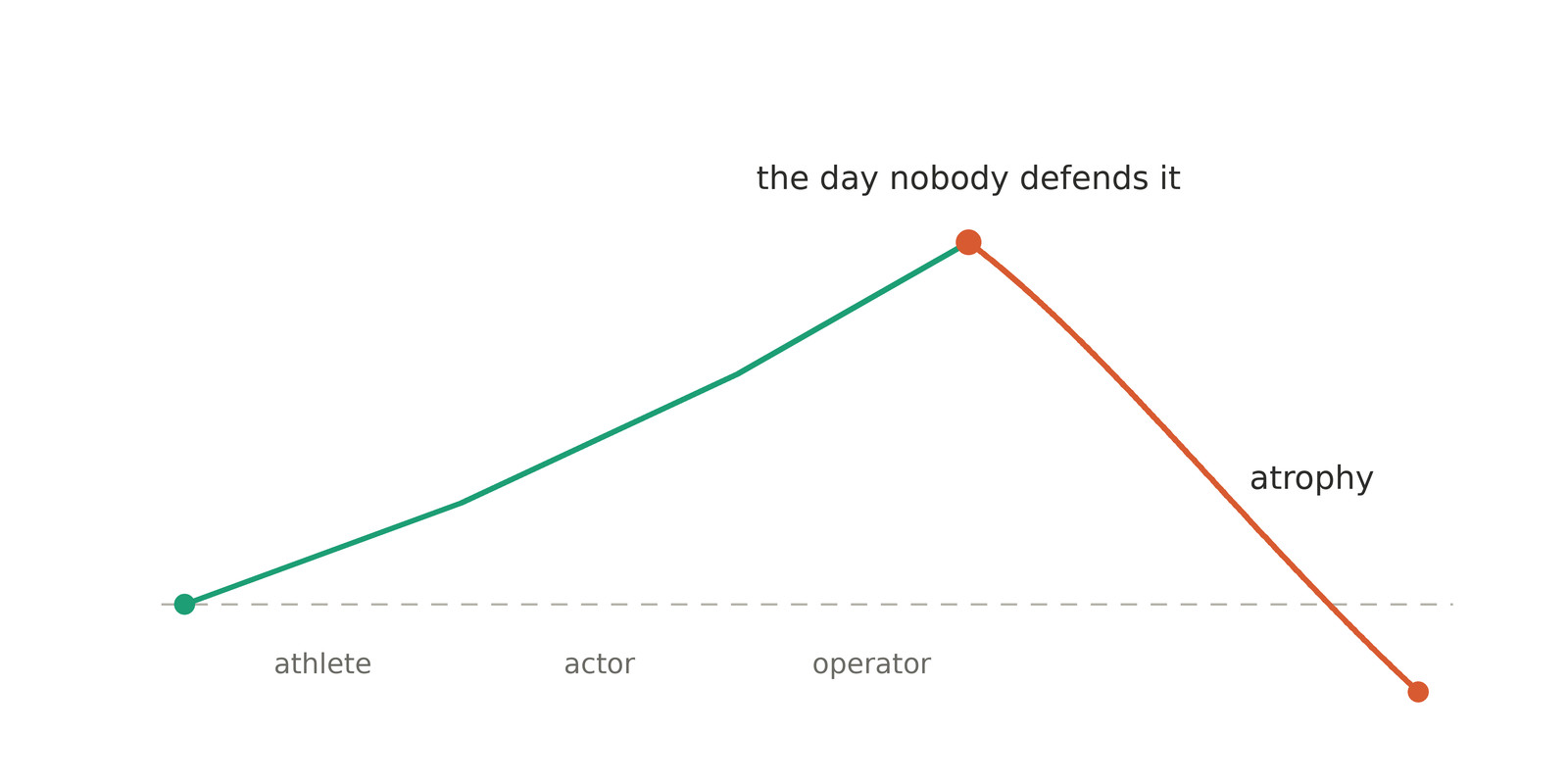
First you train like an athlete: Did the work happen? That’s the entire question. Not was it good. Not was it clever. Did you do it, today, at the volume you said you would, and can somebody else see that you did?
This is reps. It’s the least glamorous thing in the building and it is not optional. I made 250 dials a day for eighteen straight months as a broker. Nobody was checking my tone.
Then you train like an actor: Now the question changes. Now it’s how it was done. The opener. The questions. The wording of the ask. The silence you’re too uncomfortable to leave sitting there.
My acting teacher, Eric Morris, spent years drilling into me that the craft and the instrument are two different things — the material is one problem, and the person delivering it is another. You learn the words cold precisely so you can stop thinking about them and be present with whoever’s in front of you. Salespeople almost never get taught this. Actors get taught nothing else.
Then you train like an operator: The Wall Street stage. And the question changes again: was that the right thing to do at all?
Right account. Right moment. Right ask, this week, to this person, instead of the other forty things you could have done with the hour. This is judgment, and it’s the only one of the three that can’t really be scripted.
Count. Craft. Judgment. In that order, and no rung gets skipped.
In 1967 two psychologists, Paul Fitts and Michael Posner, published a book called Human Performance in which they proposed that motor skills are learned in three stages: cognitive, associative, autonomous. Early on, everything takes conscious attention. Eventually the skill runs almost by itself, and the attention that used to go into producing it gets freed up for reading what’s happening around you.
That’s a tennis player who no longer thinks about the serve and can therefore think about where the opponent is standing.
Same architecture. Sixty years old. It’s in every coaching curriculum there is.
And elite performers drop back down into the earlier stages on purpose, to rebuild something and come out higher. So the stages aren’t a staircase you climb once and leave behind. They layer. You never stop counting the reps just because you got good at the wording. I still count mine.
I read Fitts and Posner twenty-one years ago. Not for work.
My daughter was born with brain damage that affected her motor skills.
We were told she wouldn’t make it out of the NICU alive. My wife said, “not on my watch.” Then my sister got my daughter out of that NICU and helicoptered her to Long Island. Then my wife went to work. Then me, then our other two daughters, and eventually my daughter herself. She still does the work.
Every day since she came home. Twenty-one years. Every. Single. Day.
People hear this story, see my daughter, and often say, “It’s a miracle. Thank God.” Please forgive me and I’m sorry, but God had nothing to do with it. It was my wife. Then my sister. Then all of us, doing the same exercises over and over and over.
Or else what?
Atrophy. That’s what else. Atrophy that turns into not being able to tie her shoes anymore. Then maybe not walking.
So she does it.
Cognitive, associative, autonomous. Over and over, in that order, because there isn’t another order that works.
So when I tell you there’s a sequence and it can’t be skipped, that isn’t a citation. It’s twenty-one years of mornings.
Everybody wants to start at stage two. Craft is interesting. Craft feels like the real work. Nobody ever got excited about a tally.
Everybody starts at stage one anyway. Every time, no exceptions, however senior they are and however good last quarter looked. And it isn’t because I don’t believe your people are working.
Here’s what stage one actually is, which is more than volume.
It’s the volume, first. Most people genuinely aren’t doing it, and that’s the easy half.
Then it’s the habit of recording it. Writing it down, the same way, every day, so the number exists whether the week went well or badly. That’s a skill in itself, it takes weeks to build, and you don’t get it by being told the standard once.
And then it’s counting the right three things. Ask a sales floor what they track and you’ll get dials, or meetings booked. I count contacts, commitments and referrals. Who you actually spoke to. What they agreed to do next, in words, on the call. And who else they put you on to. Almost nobody arrives already counting those three, which means almost nobody has stage one, whatever the dashboard says.
That’s why we start there with a twenty-year veteran and a first-week hire alike. Not to insult the veteran. Because until those three numbers exist, written down every day by the person doing the work, there’s nothing underneath any of the rest of it.
Somebody counted something in January and nobody defended it by March, so the number drifts, and the drift goes unnoticed until a quarter comes in soft and everyone’s surprised.
Measuring isn’t holding. Naming isn’t training.
Stage one isn’t the number existing. It’s the number being defended every day by somebody whose job it is to defend it.
Here’s what most companies do instead. They book a training day. Somebody good comes in, everybody nods, there are role-plays, the energy in the room is genuinely great.
Then, according to ATD’s own State of Sales Training report citing Gartner, B2B reps forget 70% of it inside a week and 87% inside a month.
That’s not a knock on the trainer. The trainer was probably excellent. It’s a knock on the format. Craft is a rehearsal problem, and you cannot rehearse somebody once in March and expect the performance to hold in September.
Nobody would run a club this way. You’d never bring in a specialist for one Tuesday, work on finishing for four hours, then not look at anybody’s finishing again until the following spring.
We do exactly that with the people carrying our revenue, and then we go looking for a motivation problem.
This is the part I’d underline if I could only leave you with one thing.
The order is right, but the order isn’t the product. Consistency is.
Run it properly for six weeks and then stop, and nothing bad happens on Monday. Or the week after. It goes slowly. The volume slips a little, the recording gets patchy, nobody’s defending the number anymore, and one day you look up and you’re back where you started. Or lower.
Atrophy. Same word. Same thing.
You’ll know it’s gone before any report tells you. It shows up like this:
Performance that swings: A good month, then a bad one, and nobody can tell you why either happened. When the underlying work is steady, results still move around, but they move around a line. When there’s no line, you don’t have a system. You have a series of moods.
A pipeline nobody will put a date on: Bloated with deals that have been alive for months, all of them technically still open, none of them with a commitment in words from the buyer about what happens next. That pipeline isn’t optimism. It’s a filing cabinet for conversations nobody wants to close out.
People who talk, and keep talking: In the stand-up. In the sales meeting. In the strategy conversation that could have been four minutes and ran forty. Watch who does it and you’ll notice it’s rarely the people with the best numbers. Talking about the work looks close enough to the work that it gets offered as a substitute for it, and in most companies it’s accepted as one.
None of those three is a talent problem. All of them are what a standard looks like a few weeks after everybody quietly stopped defending it.
I’m not going to tell you I wish I’d done it differently. I couldn’t have seen any of this without doing all of it, and the order life handed me is how I got the material.
What I will tell you is that nobody ever laid the sequence out for me. Not one coach, not one sales manager, not one director. I had to go get all four pieces myself and then be around long enough to notice they fit together.
You don’t have to do it that way. That’s the only reason I wrote this down.
I’m not teaching you what I used to do.
Four o’clock. Brain work, cold water, the gym. A tape for a commercial. Four calls asking for money.
Athlete, actor, operator.
It’s what I did today.
Founder of Mettle & Method. Forty years across professional football, Wall Street, acting and high-ticket sales — still selling, still acting, still training.