
I studied with Eric Morris for twelve years. People left that room in tears. Not occasionally. Most weeks.
He’d let you get three lines in and stop you. He’d tell you it was dead. He’d tell you that you were indicating, that you were showing him a feeling instead of having one, that nothing coming out of you was real and everybody sitting there knew it. In front of thirty people. Some of them famous.
Brutal. I’ve used that word about him for thirty years and I’ve never looked for a softer one.
And I’d put him up against any teacher I’ve ever had, in any arena, including the ones who had a whistle.
Here’s the thing I didn’t work out until much later. In twelve years I never once heard him criticize anybody.
Everybody thinks the problem with criticism is tone. So they fix the tone. They soften it, they pad it, they sandwich the real sentence between two compliments so it comes out the far side hard to find. Then nothing changes and they decide the person wasn’t coachable.
It was never the tone. It’s the tense.
Criticism is past tense and it’s closed. It’s a verdict about who somebody is. You’re lazy. You don’t listen. You’re not really a closer. The soft version is the same verdict with a nicer voice on it — I’m just not sure this is your strength. That one’s worse, actually, because there’s nothing in it to argue with and nothing in it to do.
A correction is about the next one. It assumes there’s going to be a next one.
That’s the whole difference and it took me twenty years to find the word, which I had the entire time, because I’d been using it on my kid before I ever noticed I was using it.
Morris would take an actor apart on the floor and every single thing he said pointed at the next time they got up there. He wasn’t describing you. He was describing what you did, which is a different object entirely, and one you can pick up and move.
You can take that forever. I took it for twelve years and I’d go back tomorrow
A criticism is free.
That’s the part nobody says out loud. Telling somebody who they are requires no preparation. You can do it from across the room, half-listening, between two other things. He’s just not hungry enough. Done. Costs nothing, feels like leadership, and you get to go back to your desk.
A correction costs you. To tell somebody what to do differently on Tuesday you have to know what they actually did on Thursday. You have to have listened to the call. The whole call, not the part where it went wrong. You have to know enough about the work to have an opinion about the next rep that’s worth anything.
So most managers criticize. Not because they’re unkind. Because the other thing takes an hour they don’t have, and the verdict takes four seconds and lands with the same weight in the room.
I did it for years. I ran floors where I told people what they were and thought I was being direct. I wasn’t being direct. I was being lazy, and direct was the story I told myself about it.
I’ve got a sixteen-year-old who plays at a level where people have opinions about him every single day.
He makes a mistake, the head goes down. Every kid’s head goes down.
Correction.
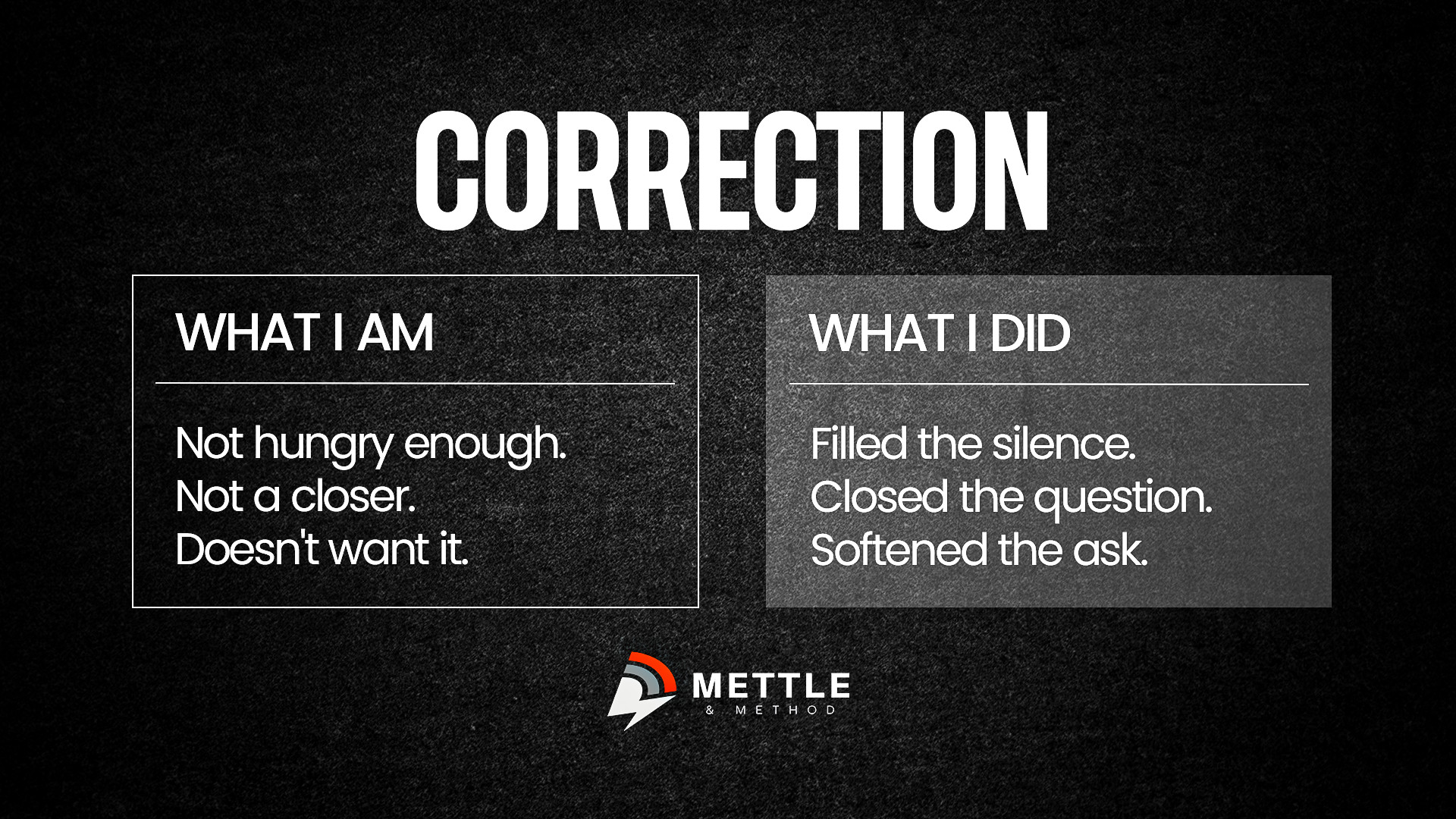
That’s the word. I’ve said it to him so many times he can hear it coming, and it does one thing — it takes what just happened and moves it out of the column marked what I am and into the column marked what I did.
That’s all it does. It’s not encouragement and I’m not interested in encouragement. He doesn’t need me to tell him it was fine. It wasn’t fine, he knows it wasn’t fine, and if I told him it was he’d stop listening to me about anything.
He needs the ball to still be in play. Correction keeps it in play.
Encouragement and criticism are actually the same move from opposite ends — both of them are a verdict handed down about the person, and both of them are finished the second the sentence ends. One feels nicer. Neither one tells you what to do.
I send a rep I work with written reviews of his live calls. Line by line. Where the question closed when it should have opened, where he filled a silence that was doing work for him, where the ask went soft.
He has taken every one of them and pushed back on exactly none.
That’s not because I went easy. Read one and you wouldn’t call it easy. It’s because there’s nothing in any of them he has to defend himself against. Nowhere in any of those documents does it say what kind of salesperson he is. It says what happened at 14:06 and what to do at 14:06 next week.
Nobody defends themselves against a thing that isn’t about them.
Here’s one, so it’s not abstract. He gets to the end of a good call and asks for the next step and then, in the two seconds of quiet that follow, he starts talking again. Fills it. Offers a smaller version of what he just asked for.
The criticism is you’re not confident enough. True, probably. Also useless. He can’t go into Thursday’s call and do confidence.
The correction is: ask, then say nothing until he answers. Count if you have to. You will want to fill it and the wanting is the point — it’s the most uncomfortable four seconds in the job and it’s where the whole thing is decided. Be brave enough to let the silence do its work.
One of those he can act on at two o’clock on Thursday. The other one he can only be.
And here’s what you get on the other side of it, which is the part worth having: he brings me the bad calls now. He doesn’t wait for me to find them. A person who’s being corrected goes looking for more of it, because more of it makes him better and it costs him nothing he cares about. A person who’s being criticized hides the tape. Same person. Same manager. Different tense.
Think about the last conversation you had with your best salesperson about a call that went badly.
Not what you meant. What you said.
Is there a next rep in it? Is there one sentence in there that describes a thing to do, at a specific moment, the next time that moment arrives?
If there isn’t, you didn’t coach anybody. You told a person who they are, and then you went back to your desk, and three weeks later you noticed they’d gone quiet and you wondered what that was about.
The soft ones count too. I need you to want it more is a verdict. You’ve got to be hungrier is a verdict. Half the sales management in the world is verdicts delivered in a warm voice and then a genuine puzzlement about why nobody improves.
You cannot act on who you are. You can only act on what you do next.
Eric never told me I was good. Twelve years, not once.
He told me what to do the next time. Every time. And then the next time came, and I did the work, and he told me again.
I still do that work. Thirty years on, in a room with a camera on a tripod and a sheet of paper taped to the wall behind it, before anybody has asked me for anything — I do the work he gave me.
A criticism is finished when the sentence is.
A correction is still running thirty years later, in a room he’s never been in, and he has no idea I’m in there.

Founder of Mettle & Method. Forty years across professional football, Wall Street, acting and high-ticket sales — still selling, still acting, still training.