

It’s Wednesday afternoon. A message lands in the channel.
How’s it looking for deals this week?
Nobody meant anything by it. The person who typed it runs the company, has payroll on the fifteenth, and has been carrying a number in their head since Sunday night. It took four seconds to send. They’d tell you, honestly, that it wasn’t pressure.
It isn’t pressure. It’s just a question.
And it will show up on a call at 3:40 that afternoon, in a voice the buyer has never heard before.
Here’s what nobody watches happen, because it happens inside a person.
The rep reads the message. Nothing dramatic. A small tightening. They look at the pipeline and do the arithmetic that everybody in that seat does — which of these could I possibly close by Friday, and what would I have to say to make that happen.
Then they get on a call with somebody who was, until that moment, a perfectly normal conversation.
And they push. Not obviously. They ask for the close a beat early. They fill a silence they should have left sitting there. They answer a question that wasn’t fully asked yet. They suggest a next step that suits the calendar in their head rather than the one in the buyer’s.
The buyer doesn’t think any of that consciously. What the buyer thinks is: something’s off here. And what they say is, “let me think about it.”
So the question that was asked in order to produce revenue is the thing that cost it.
I’ve watched this from both chairs. I’ve been the rep reading the message. These days I’m often the one people expect to send it.
This is the part that usually gets skipped, because it’s more satisfying to write about bad managers.
Almost nobody sends that message because they enjoy it. They send it because it is the only instrument they have.
Think about the position. You own the company or you run it. You do not sell — you may never have sold, which is exactly why you hired someone who does. You are genuinely too busy to sit and examine how the selling actually works. And you cannot see the pipeline. Not really. You can see a CRM that somebody may or may not have updated, and a number at the end of the month that arrives like weather.
What lever is left?
Asking. That’s the lever. So they pull it.
It’s a fair thing to want. It just happens to be the one action guaranteed to make the thing they want less likely.
I studied with Eric Morris in Los Angeles for twelve years. He’s ninety-four now and still teaching three nights a week.
Here is what a class looked like.
The first hour, sometimes ninety minutes, no one performed anything. A studio full of working actors lying on the floor doing relaxation scans. And asking themselves, over and over, one question.
How do I feel?
Then answering it. Out loud.
That’s it. That’s the exercise. And it is far harder than it sounds, because the first four answers are always lies — the answer you think you should give, the answer that sounds interesting, the answer you gave last Tuesday. You have to go through those to get to what’s actually there.
Only after that did anybody get up and work on a scene.
If you came to class without material to work on — which Eric actually preferred — he’d give you an exercise instead. Not a random one. One chosen for whatever he’d decided was your particular obstacle, the thing standing between you and simply being present, which is the only place any real work can start from.
His favorite was the vulnerability exercise. He’d put you on stage in front of everybody and make you say things about yourself you hadn’t admitted in your own head, let alone out loud. Sometimes he’d have you do it in a silly voice. Sometimes he’d hand you an imaginary circumstance to play while you said it.
It was brutal. I don’t have a softer word. I said things and heard things and watched things in that studio that have stayed with me ever since.
I have also never worked better or booked more jobs than during the years I was doing that work.
Here’s the connection, and it took me a long time to see it.
You cannot stop the message from arriving. You can’t stop having payroll, and you can’t stop an owner from wanting to know. The pressure is a permanent feature of the environment.
What you can change is the state of the person who receives it.
A rep who has spent ten minutes that morning asking themselves how they actually feel — and answering honestly — reads that message and notices something. That landed on me. I’m carrying it. It’s here in my chest and it will be in my voice at 3:40 if I don’t set it down.
A rep who has never done that work in their life doesn’t notice anything. They just walk into the call as a slightly different person than they were an hour earlier, and they have no idea, and the buyer picks it up in the first ninety seconds.
This isn’t mysticism. It’s the difference between carrying something and knowing you’re carrying it.
Actors train this. It’s the first thing they train, before any craft at all, because a blocked instrument makes every technique useless. Athletes train it under other names. Musicians train it.
Salespeople don’t train it at all. There is not a salesperson alive today doing this work — unless they work with me.
That’s not a boast. It’s an indictment of an entire profession that trains scripts and objection-handling and CRM hygiene and has nothing whatsoever to say about the state of the human being who has to execute all of it.
Nobody is lying on the floor of your office.
Although — and this only occurred to me recently — a good number of people reading this work from a spare bedroom, twelve feet from where they sleep, with nobody watching. So it’s a less strange proposition than it was ten years ago.
There are two parts to it.
The first happens at home, before the day starts. Before you leave for the office or before you step into the one down the hall. Relaxation. The how-do-I-feel work, answered out loud. And movement — I push hard on this one — some kind of physical work before you perform. You set your own pace on all of it. There’s no minimum and I don’t prescribe a length. It’s yours.
The second part goes on the clock and it’s far simpler than people expect.
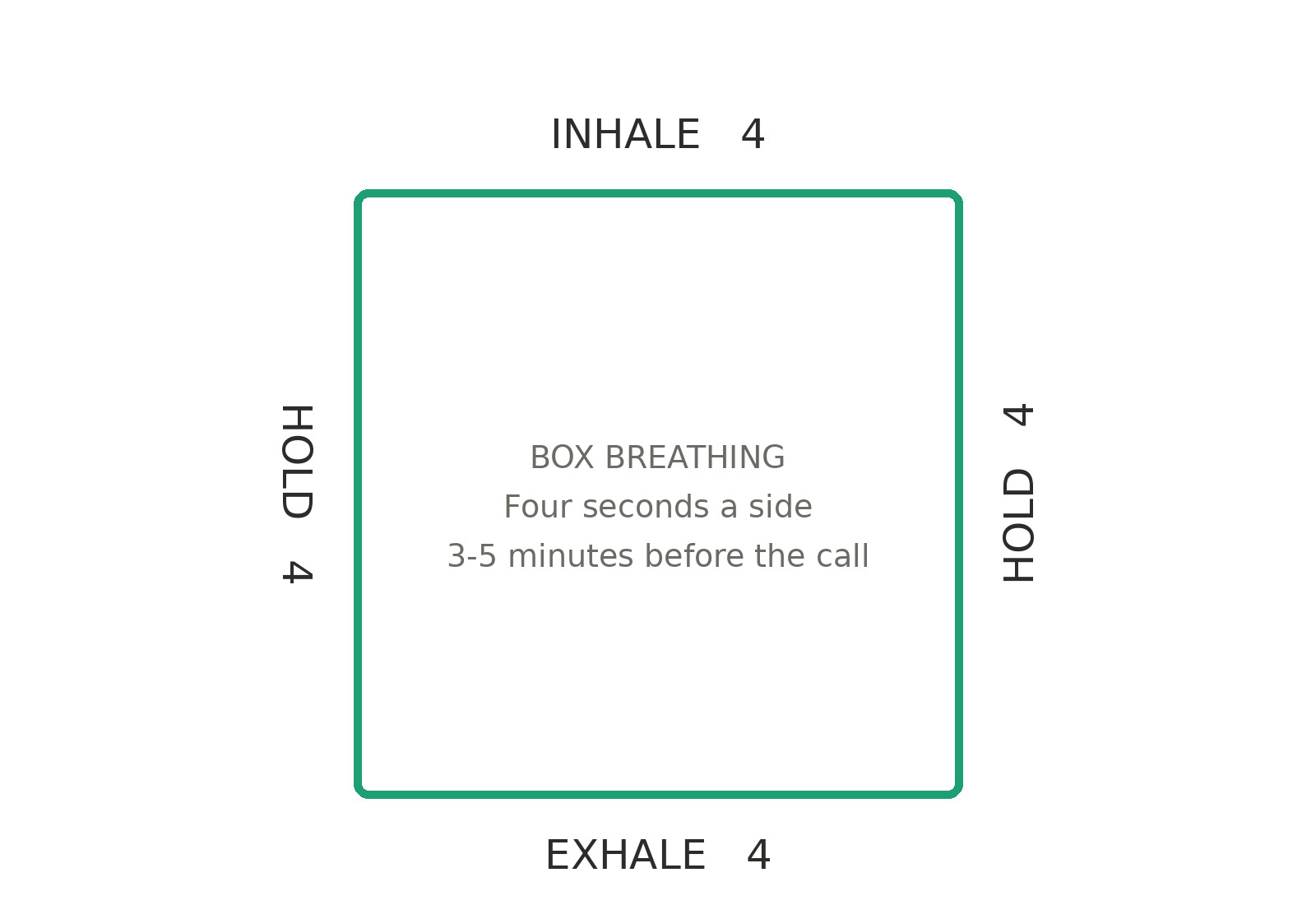
Three to five minutes of box breathing before a call. A minute or two of stretching. Same again afterward. The breathing is the part that matters most, and if you take one thing out of this piece, take that.
Now here’s where I differ from most sales training, and I’ll admit it sounds backwards.
I don’t train people to sit up straight and be alert on a call. I don’t train them to stand and project.
I want them casual. Almost aloof.
Because of what that communicates before anybody has said anything. I’m here. I know what I’ve got. With you or without you I’m still eating tonight. You need me more than I need you.
You can’t fake it. Anybody who has ever bought anything can tell the difference between a person who is relaxed and a person doing an impression of one.
Relaxation is how you get there. That’s the entire reason for it.
Not wellness. Leverage.
Everything above puts the work on the rep, and that isn’t fair, because the rep didn’t build the condition.
The person asking needs the other half.
They ask about deals because they can’t see anything else. So give them something else to see.
Not a forecast — a forecast is a guess dressed as a number, and everybody involved knows it. What they need is the work itself, visible, daily, without having to request it. How many real conversations happened. What each of those people committed to doing next, in their own words. Who else got introduced.
When an owner can see that, the Wednesday message stops. Not because anybody told them to stop. Because the question has already been answered and there’s nothing left to ask.
I’ve seen this change in a matter of weeks. The asking wasn’t a personality trait. It was a symptom of blindness, and blindness is fixable.
So there are two questions in this piece.
One of them gets asked constantly, in every company, on every Wednesday afternoon, by people who mean well and have no other lever.
How’s it looking this week?
The other one gets asked in an acting studio in Los Angeles by people lying on the floor with their eyes closed, and almost nowhere else on earth.
How do I feel?
The second one is the one that would actually answer the first.
Founder of Mettle & Method. Forty years across professional football, Wall Street, acting and high-ticket sales — still selling, still acting, still training.