
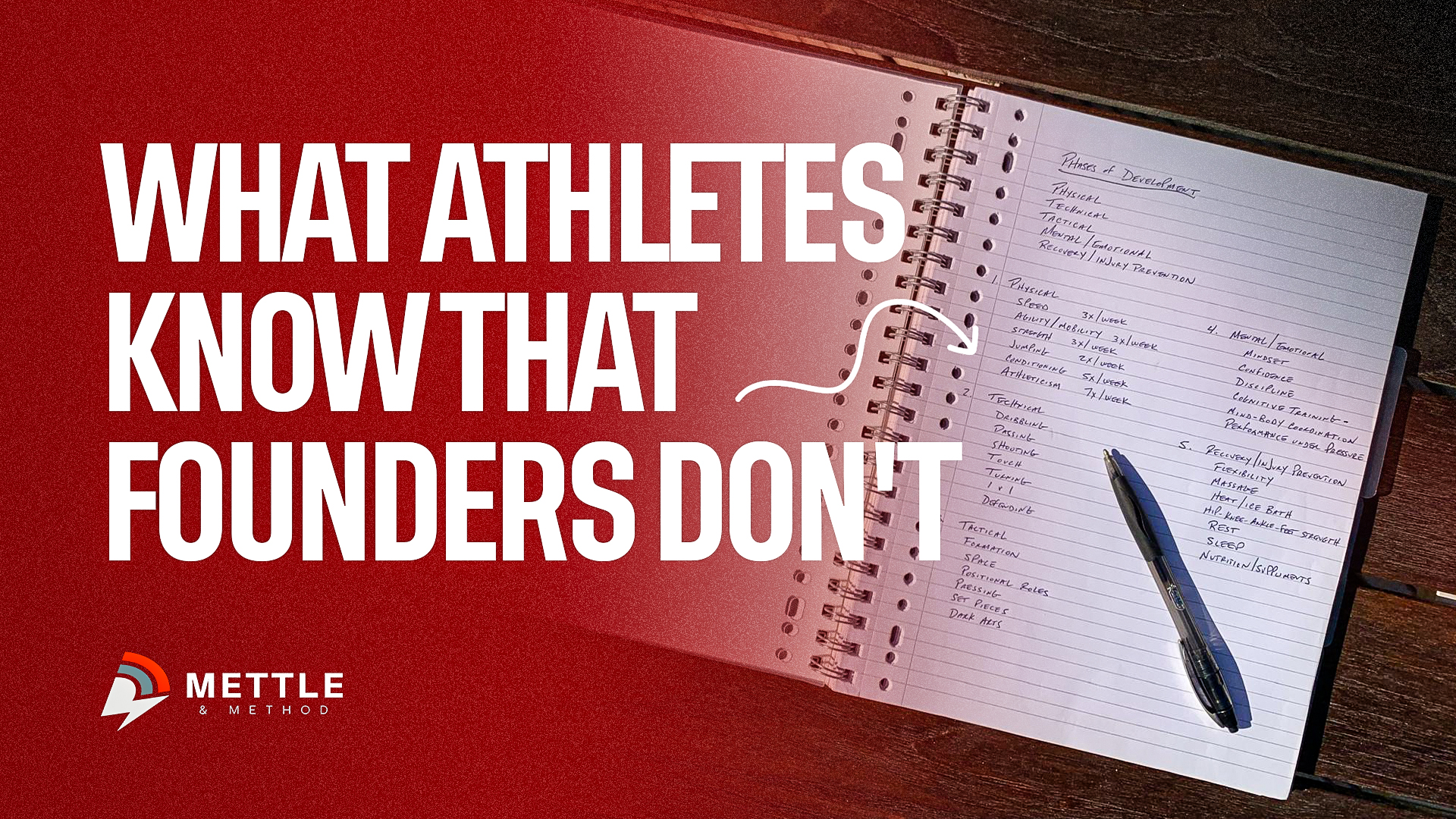
A sixteen-year-old I know gets up at six and trains for an hour before he goes to training.
Not the gym. Not conditioning. Breath work. Heat and ice. Massage. Mobility and flexibility. Hips, knees, ankles, feet. Nutrition and supplements. The same things in the same order, at home, alone.
Then he goes to the club and does another hour on his own before the session starts. Then the session. Then whatever phase of development is scheduled that day. Then the recovery work, the food, the sleep. All of it written down.
He’s not a prodigy. He’s a kid in a professional academy and there are thousands like him.
Here’s the part that matters. Ask him why he’s doing any one of those things and he can tell you which of the five phases it belongs to, what it’s supposed to move, and why it’s dosed the way it is this month and not next month.
Now go ask your best salesperson the same question about anything they did on Tuesday.
The Five Phases the kid trains have names, and they aren’t his. They’re in every coaching curriculum in the world.
Physical. Technical. Tactical. Mental and emotional. Preparation, recovery and injury prevention.
Nobody needs that explained. You knew four of them before you read them.
Now here they are again, in a company.
Yes, a company. Because a company works the same way a sports team does, which works the same way an army does. The objective is to win. And you rely on players, soldiers, salespeople to perform at their best in order to do so. The only difference is that in sports we call them phases. In business, we call them domains. I don’t know what the army calls them because I’m a pacifist.
Here’s the five:
Five. Not one. Five.
A club that trained only the top row would be relegated. Almost every sales organization measures only the top row and calls it development.
I wrote that plan. Sat down at a kitchen table with a notebook and put five headings on a page, because somebody had to and nobody else was going to.
Then I looked at the page for a while, because I’d written it before. Three times. Under different words.
I’ve spent forty years in four arenas that look unrelated. A football roster. A trading floor. Thirty years of audition rooms. A sales floor.
On LinkedIn they call that a pivot. Four pivots, which reads as range or as a man who can’t hold a job, depending on who’s doing the reading. There was no thesis. I wasn’t collecting data. I got cut, I got bored, I saw a movie, I needed money — roughly in that order — and each time I walked into a room where nobody cared what I’d done in the last one and I started again at the bottom.
I saw none of it at the time. Not a glimmer. You don’t spot the pattern while you’re in it, you’re too busy trying to eat. Sometimes you just end up somewhere, and it’s only later, adding it all up at a kitchen table with a page in front of you, that the figures compute.
Because those four arenas share exactly one thing: you get measured every day, and everybody can see the number.
Now let me be careful here, because there’s a bigger version of this claim and it’s a lie. You’d catch me at it.
Sport doesn’t do this well. Sport names it. Sports science has had physical, technical, tactical and mental written down as separate things for decades. It’s in the textbooks. It’s in the curricula. Every academy director can recite them.
Naming is not training.
How many footballers actually train all five, written down, dosed, tested? Very few. Maybe Ronaldo. Probably not Messi. Though maybe he does. He’s deceptive that way. But most don’t. They should.
So what athletes know isn’t that they’re better than you. It’s that there are five.
Founders don’t know there are five. That’s the whole gap. Not effort. Not talent. A category error. You can’t train what you never named. You can’t manage what you never counted.
I’ll use other people’s numbers here. Mine come from inside private companies and you’d be right not to take my word for it.
Quota attainment in the 2026 benchmarks: twenty-seven percent. Three out of four salespeople missing the number they were hired to hit. Read this as a talent problem if you like, but nobody hires four people expecting three to fail.
Half of reps say the coaching they get is fixated on KPIs and pipeline reviews, and what they want instead is skill. And objection handling — which has the biggest measured impact on performance of anything they track — gets about two percent of training focus.
Two percent. To the thing that moves the number most.
Objection handling is one part of Craft. Craft is one domain out of five. It’s probably the domain most likely to decide whether a conversation converts, and it’s routinely undertrained or not trained at all.
Why is that?
Spoiler alert: nobody in this story is bad at their job.
Frontline sales managers carry twelve direct reports on average. McKinsey puts somewhere between ten and forty percent of their week on actual people work — the rest is admin, meetings, forecast, and whatever caught fire that morning. Do the math yourself. Twelve reps, call it eighteen hours, ninety minutes each.
Ninety minutes a week, per person, to develop a human being.
And of the two things they could spend it on, a pipeline review takes no preparation and a craft session means listening to a recording first. On a Friday. With a forecast due. You know which one happens.
So they count activity and call it development. Report it upward as coaching. Everybody in the chain believes it’s happening. The rep knows it isn’t and says nothing, because what’s she going to say?
Picture a club that puts its players through fitness five days a week and never once looks at a first touch, a shape, a set piece, or the state of a nineteen-year-old who just lost her place in the side. Come November they’re the fittest team in the division. They’re also bottom of it.
Three things I’ve watched happen in live sales organizations. I’ve taken the names and the numbers out.
In one engagement, our baseline traced 73% of a rep’s recent revenue to a single relationship — a concentration risk nobody saw until it was measured. Not a bad rep. A very good one. The dashboard showed a strong year. Underneath it was one relationship and a very good year.
One rep changed a single word in how he asked for the next step. That’s it. One word. He got a quoted trip out of it that week. Nobody had ever listened to his ask before, which is why nobody had ever told him.
Another rep asked a closed question at the end of a strong call and got “I’ll think about it.” She’d been doing it for years. Her manager had never heard the call. Not negligence — there was no tape, and there was no line on any sheet anywhere that said the wording of the ask.
All three of those sit outside Work Rate. All three were invisible to a system that counts dials, meetings and closes. And all three had been happening every week for years, costing money the entire time, in a company that believed it was measuring performance.
Unmeasured behavior is unreliable behavior. Not because people are dishonest. Because that’s how people work, and it applies hardest to the ones who are already good at their jobs.
Get a blank page. Five rows. Work Rate, Craft, Game Plan, The Instrument, Preparation.
For each row, answer one question: what number, written down, does somebody actually check every week?
Not what you believe you measure. Not what’s in the CRM if someone entered it. A number, on paper or on a screen, that a specific human being looks at on a specific day.
Work Rate is easy. You’ll have a number.
Then keep going.
Craft — what number tells you whether the wording of the ask improved this quarter? Game Plan — what number tells you the list got rebuilt, rather than worked? The Instrument — what number tells you the state your closer was in before the call that mattered?
Then Preparation.
Go back to the sixteen-year-old for a second. Breath work. Heat and ice. Massage. Mobility. Hips, knees, ankles, feet. Food. Look at that list again.
Not one thing on it is football.
The first hour of his day, every day, goes to the domain your company doesn’t have a name for. No line on any sheet. No number attached. None of anybody’s ninety minutes. And it’s the one he does first, before he’s really awake, before anyone can see him do it.
So — what number tells you the pre-call research happened this week, and that it’ll still be happening in October?
Anything you couldn’t answer is working right now because of who’s sitting in the chair. Which is fine, right up until they leave, or you try to sell the company, and somebody who does this for a living asks whether the number is transferable.
Count the rows where you have a real answer.
It’s almost always one.
That’s the diagnosis. Twenty minutes, and it’s free.
The sixteen-year-old doesn’t know he’s doing anything unusual. Nobody told him five was a lot. He thinks that’s what training is.
I wrote his plan. He’s my son.
Founder of Mettle & Method. Forty years across professional football, Wall Street, acting and high-ticket sales — still selling, still acting, still training.